If you’re looking at the Antminer Z15 Pro in 2026, the big question isn’t simply whether the machine can mine cryptocurrency. It can. The real question is whether the hardware price, electricity rate, Zcash market conditions, network difficulty, cooling requirements, and expected lifespan make sense for your particular mining operation. That distinction matters because ASIC profitability can change dramatically even when the machine itself performs exactly as advertised. Bitmain’s official documentation lists the Z15 Pro at approximately 840 KSol/s, with wall power around 2,650 watts at 25°C, while current third-party mining calculators show materially different revenue and profit figures depending on the market snapshot and electricity assumptions. Buy the Antminer Z15 Pro in stock now.
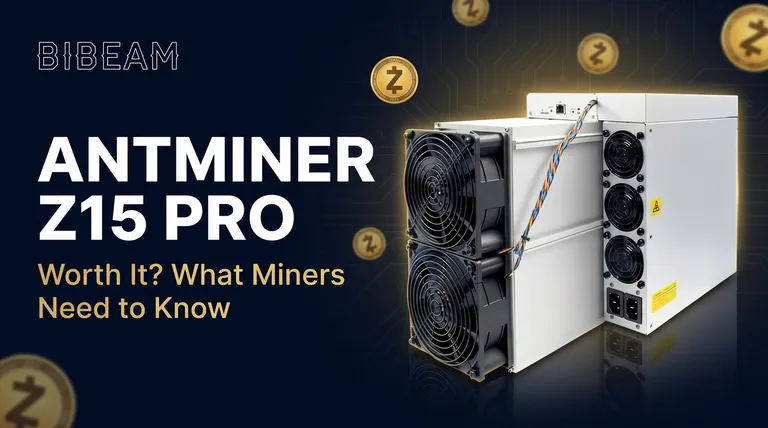
The Z15 Pro is a specialized Equihash ASIC, primarily associated with Zcash and Horizen mining rather than Bitcoin’s SHA-256 algorithm. That makes it a completely different proposition from an Antminer S21, S21 XP, or other Bitcoin-focused machine. You are not buying a general-purpose crypto miner; you’re buying a specialized piece of hardware designed to perform one type of computational workload extremely efficiently. Current September 2026 profitability data illustrates just how important market conditions are: different calculators currently report daily net profitability figures ranging from roughly the mid-$40s to around $50 or more under a $0.10/kWh electricity assumption, while other snapshots using cheaper electricity produce substantially higher numbers.
That variation is exactly why anyone considering a Z15 Pro should avoid looking at a single profitability number and treating it like a guaranteed paycheck. Mining revenue moves with coin price, network hashrate, mining difficulty, pool fees, block rewards, and ultimately the amount of cryptocurrency the machine can produce. A machine that looks spectacular on a calculator today can have a very different return profile several months later. So, is the Antminer Z15 Pro worth it? The answer depends heavily on what you pay for the machine and electricity, how long you plan to operate it, and how much volatility you are willing to accept.
What Is the Antminer Z15 Pro?
The Antminer Z15 Pro is a Bitmain ASIC miner designed for the Equihash algorithm. Unlike GPU mining hardware, an ASIC is purpose-built: its chips are engineered around a particular computational task, allowing it to deliver much higher performance per watt for that task than general-purpose hardware. Bitmain’s documentation identifies the Z15 Pro as model 240-Z, with a rated hashrate of 840 KSol/s ±3%, wall power of approximately 2,650 W ±10%, and energy efficiency around 3.15 J/KSol ±10% at 25°C. The machine accepts approximately 200–240V AC input and uses an Ethernet connection for networking.
That specification immediately tells an experienced miner something important: this is not a small desktop device that you casually plug into a household outlet next to your computer. At roughly 2.65 kW, running continuously means approximately 63.6 kWh of electricity per day before considering any variation in actual operating consumption. Over 30 days, that is roughly 1,908 kWh. At $0.10 per kWh, the electricity component alone would be around $190.80 per month; at $0.05 per kWh, it would be about $95.40. Those numbers show why electricity remains one of the most important variables in any ASIC mining calculation.
The physical specifications matter, too. Bitmain lists the bare machine at approximately 428 × 195 × 290 mm and about 16.95 kg, with an operating temperature range of 0–40°C and operating humidity of 10–90% non-condensing. The Z15 Pro uses two 12038 fans, and Bitmain’s fan documentation lists a Z15 Pro front-fan speed of up to 7,100 RPM. In practical terms, that means prospective buyers need to think about heat, airflow, noise, electrical capacity, and physical placement before thinking about ROI.
Z15 Pro Specifications at a Glance
| Specification | Antminer Z15 Pro |
|---|---|
| Manufacturer | Bitmain |
| Algorithm | Equihash |
| Primary mining assets | Zcash / Horizen |
| Rated hashrate | 840 KSol/s ±3% |
| Official wall power | 2,650 W ±10% |
| Official efficiency | 3.15 J/KSol ±10% |
| Input voltage | 200–240V |
| Network | RJ45 Ethernet |
| Dimensions | 428 × 195 × 290 mm |
| Bare weight | Approximately 16.95 kg |
| Operating temperature | 0–40°C |
| Operating humidity | 10–90% RH |
The specifications above come from Bitmain’s published Z15 Pro documentation. Third-party listings may quote figures such as approximately 2,780 W and 3.31 J/KSol, reflecting different operating assumptions or configurations, so buyers should verify the exact batch and condition of the machine they are purchasing rather than relying on one marketplace listing.
How the Z15 Pro Makes Money
The Z15 Pro generates mining revenue by contributing computational work to an Equihash-based blockchain network. In a conventional pool-mining setup, the ASIC connects to a mining pool, receives work, performs the required calculations, and submits valid shares. The pool aggregates the work of many miners and distributes rewards according to its payout system and the miner’s contribution. The result is a stream of cryptocurrency-denominated revenue rather than a fixed dollar payment.
This distinction is crucial. If the machine produces a certain amount of ZEC, the dollar value of that production changes whenever the market price of ZEC changes. Imagine a vending machine that gives you one token every day, but the value of that token can move from $50 to $100 or from $100 to $40. The vending machine has not changed, but your financial outcome has. ASIC mining works in a similar way: the hardware determines your production capability, while the market determines what that production is worth.
Current September 2026 estimates demonstrate this volatility. One mining calculator recently estimated approximately $58.77 per day in gross Equihash revenue and around $52.41 per day in profit at a $0.10/kWh electricity rate, while another calculator showed approximately $44.31 daily profit under a similar electricity assumption. These differences are not necessarily evidence that one machine suddenly became better or worse; they reflect the fact that profitability calculations depend on the exact market data, network conditions, power assumptions, fees, and timestamp used by each calculator.
For that reason, miners should think in terms of ranges and scenarios, not promises. A sensible Z15 Pro spreadsheet should include a conservative revenue case, a base case, and a strong-market case. You should also test what happens if ZEC falls substantially, network difficulty increases, or your electricity rate rises. If your investment only works under perfect conditions, the investment is fragile.
Understanding Equihash Mining
Equihash is fundamentally different from the SHA-256 algorithm used by Bitcoin. That means comparing a Z15 Pro’s 840 KSol/s directly with the terahash figures displayed by Bitcoin ASICs would be meaningless. The units and computational workloads are different, so the correct comparison is between machines targeting the same algorithm and economic ecosystem.
The specialized nature of the Z15 Pro can be an advantage because its hardware is highly optimized for Equihash. At the same time, specialization creates a major limitation: your resale and alternative-use options are narrower than those of general-purpose computing equipment. If the economics of Equihash mining deteriorate, you cannot simply switch the Z15 Pro over to Bitcoin mining. Its hardware is designed for its intended algorithm.
That creates a central trade-off. ASIC specialization can deliver impressive efficiency, but specialization also concentrates risk. A miner who understands that trade-off may be comfortable with it, while someone who wants maximum flexibility may prefer hardware with broader potential uses.
Z15 Pro Hashrate and Power Consumption
Hashrate tells you how much computational work the miner can perform, while power consumption tells you what you are paying to operate that computational capability. The Z15 Pro’s official rating of approximately 840 KSol/s paired with approximately 2,650 W is the starting point for evaluating its economics. Bitmain’s official documentation gives an efficiency figure of approximately 3.15 J/KSol, although real-world third-party listings commonly quote around 3.31 J/KSol depending on the specific power and hashrate figures used.
For a continuously operating miner, the electricity calculation is straightforward. At 2.65 kW, 24 hours of operation consumes approximately 63.6 kWh. That means electricity costs approximately $3.18 per day at $0.05/kWh, $6.36 at $0.10/kWh, $9.54 at $0.15/kWh, and $12.72 at $0.20/kWh. Over a year, continuous operation would require approximately 23,214 kWh, before accounting for downtime or variations in power draw.
That is why a miner who says, “My electricity is only a few cents cheaper per kilowatt-hour,” may actually be describing a meaningful difference over a full year. A $0.05/kWh difference represents roughly $1,160.70 in annual electricity cost at 2.65 kW continuous consumption. When you operate multiple machines, the difference multiplies quickly.
Why Efficiency Matters
Efficiency is particularly important when cryptocurrency mining becomes competitive. Suppose two miners generate similar revenue, but one consumes significantly more electricity. When coin prices decline or difficulty increases, the less efficient machine can reach its economic limit sooner. The efficient machine has a larger cushion between revenue and electricity expense.
The Z15 Pro’s efficiency is therefore one of its most important characteristics, especially for professional operators paying commercial or hosted electricity rates. However, efficiency alone does not determine whether you should buy one. A highly efficient ASIC purchased at an excessive hardware price can still deliver a poor return. Conversely, a slightly less efficient machine purchased cheaply may produce an attractive short-term payback if electricity is inexpensive.
The better approach is to evaluate total cost of ownership: hardware price, electricity, pool fees, hosting, repairs, downtime, shipping, customs, taxes, and eventual resale value. Mining is not just a hashrate competition. It is an operating business where margins can be squeezed from several directions at once.
Antminer Z15 Pro Profitability in 2026
Current profitability data for the Z15 Pro is unusually variable, which is itself an important piece of information for buyers. September 2026 calculators show the machine producing materially different estimated daily profits depending on the assumptions used. For example, MiningBoard recently reported roughly $52.41/day at $0.10/kWh, while another snapshot showed approximately $44.31/day under the same nominal electricity rate. Meanwhile, a separate calculator using a $0.045/kWh assumption reported significantly higher net figures.
This is exactly why the phrase “Z15 Pro makes $X per day” should always be followed by a question: According to which data, at what electricity price, on what date, and before or after which fees? Without those details, the number has very little analytical value.
At $0.10/kWh and 2.65 kW, electricity costs approximately $6.36 per day. If gross mining revenue were $55 per day, the simple operating margin before pool fees and other expenses would be about $48.64. If revenue fell to $35 per day, the same electricity bill would leave approximately $28.64. If revenue fell to $10 per day, the economics would look completely different.
The lesson is simple: profitability is a moving target. A Z15 Pro can be profitable today without being profitable for the entire period required to recover your purchase price. Anyone calculating ROI should therefore model several months of declining revenue rather than assuming today’s profitability remains constant.
Electricity Cost and Break-Even Economics
Electricity is the easiest variable to calculate and one of the easiest to underestimate. The Z15 Pro’s approximate 2.65 kW draw means that even a relatively cheap power rate becomes a substantial monthly expense. At $0.05/kWh, the monthly electricity bill for continuous operation is around $95.40. At $0.10/kWh, it is approximately $190.80. At $0.15/kWh, it rises to about $286.20.
Those figures do not include cooling or facility overhead. If you are operating the ASIC in a climate-controlled room, the actual energy cost associated with the mining operation can be higher. In a professional hosting environment, the provider may incorporate electricity, cooling, space, network access, maintenance, and other services into a single rate. That can make your accounting easier, but it does not eliminate the underlying expense.
Why Your Power Rate Changes Everything
Consider two miners who buy identical Z15 Pro units at the same price. Miner A pays $0.05/kWh, while Miner B pays $0.15/kWh. The difference is $0.10/kWh, which works out to approximately $6.36 more per day at 2.65 kW. Over 365 days, that difference is approximately $2,321 for one machine.
Now multiply that by ten machines and the annual difference exceeds $23,000. Suddenly, the electricity contract becomes just as important as the ASIC model itself.
This is why large mining operations often focus heavily on energy procurement. A miner buying one machine might obsess over whether the hardware costs $5,000 or $6,000. A farm operating dozens or hundreds of machines has to think about the long-term power rate because a few cents per kilowatt-hour can compound into a large operating expense.
Before buying a Z15 Pro, calculate your exact electricity rate, including demand charges, taxes, hosting markups, and other applicable fees. A calculator that uses only the advertised cents-per-kWh rate may give you an unrealistically optimistic result.
Z15 Pro Hardware Price and ROI
Hardware price is where the Z15 Pro becomes particularly interesting. Current marketplace and mining-service listings show significant variation in asking prices. One current listing shows a Z15 Pro around $3,382, while another September 2026 source lists different batch prices ranging from several thousand dollars to above $10,000 depending on delivery timing and inventory.
That huge spread changes the investment calculation completely. If a machine costs $3,500 and produces $40 of daily net profit, the simple payback calculation is around 88 days. If the same machine costs $10,000, the theoretical payback stretches to approximately 250 days. But neither number should be interpreted as a guaranteed ROI because daily mining profit will not remain constant.
One particularly important issue is future difficulty. If more Z15 Pro machines enter the network, competition can increase. More network hashrate can reduce the amount of cryptocurrency earned by each individual machine. At the same time, changes in ZEC’s market price can increase or decrease the dollar value of the coins being mined.
The best ROI calculation therefore isn’t simply:
Hardware price ÷ today’s daily profit = ROI.
Instead, use a model that includes declining revenue, electricity inflation, downtime, maintenance, pool fees, and potential resale value. That model may look less exciting, but it gives you a much more realistic picture of the investment.
Z15 Pro vs. Other Equihash Miners
The Z15 Pro should primarily be compared with other Equihash ASICs, not Bitcoin ASICs. One current mining-market comparison shows the Z15 Pro at approximately 840 KH/s and 2,780 W, while the Z15 K is listed around 525 KH/s and 2,483 W. The same source also lists the older Z15 at approximately 420 KH/s and 1,510 W.
The comparison reveals an important point: the newest or most powerful machine isn’t automatically the best purchase at every price. Hardware economics depend on the relationship between acquisition cost, hashrate, energy efficiency, and expected operating life.
Z15 Pro vs. Z15
The original Z15 consumes considerably less electricity than the Z15 Pro, but it also delivers substantially less hashrate. If your facility has strict electrical limitations, the older model could have a practical advantage because you can operate more units within a fixed power budget. If electricity is cheap and rack capacity is plentiful, the higher-performance Pro model may be more attractive.
The Z15 K creates another interesting comparison. It offers lower hashrate and lower total power consumption, but its efficiency is weaker than the Pro according to current marketplace data. This illustrates why miners should not evaluate ASICs by watts or hashrate alone.
A useful comparison should always calculate profit per dollar invested, profit per kilowatt-hour, and profit per unit of physical infrastructure. Those three perspectives can produce very different answers.
Cooling, Noise, and Infrastructure
The Z15 Pro’s approximately 2.65 kW power draw eventually becomes approximately 2.65 kW of heat that needs to go somewhere. That heat does not disappear. In a small room, the temperature can rise quickly unless hot air is exhausted effectively.
Bitmain specifies an operating temperature range of 0–40°C, while its fan documentation lists two 12038 fans for the Z15 Pro. A mining setup therefore needs strong airflow and sensible intake and exhaust design. In hot climates, the challenge becomes even more serious because the ambient air entering the miner is already warm.
Noise is another practical issue. High-speed ASIC fans are not designed to be quiet office equipment. If you plan to mine at home, consider the acoustic environment before purchasing. A miner that looks excellent on a spreadsheet can become extremely inconvenient if the heat and noise make the room unusable.
Professional hosting can solve many of these problems, but hosting introduces another expense. The right question is not whether hosting is “better” than home mining. It is whether the total hosted cost gives you a more reliable operation than what you could build yourself.
Buying a New or Used Z15 Pro
Buying new gives you the benefit of knowing the machine’s condition, but used equipment can sometimes offer a lower entry price. The trade-off is that an ASIC’s history matters. A machine operated continuously in high temperatures, with excessive dust or poor maintenance, may have a different remaining lifespan from one operated in a clean, temperature-controlled environment.
Before buying a used Z15 Pro, ask for operating information, photographs of the actual unit, hashrate screenshots, board temperatures, fan status, error logs, and proof that the machine powers up normally. You should also verify the serial number and warranty situation where applicable.
Shipping deserves attention as well. A cheap machine can become less cheap after shipping, import duties, taxes, payment fees, and possible repair costs. The real acquisition cost is the amount required to get a working ASIC installed and mining at your facility.
For new equipment, verify the exact model and batch. Marketplace listings sometimes mix specifications between versions or quote estimated power consumption rather than the manufacturer’s official figure. When possible, compare the seller’s claims against Bitmain’s documentation before sending payment.
Common Risks Z15 Pro Buyers Should Consider
The biggest risk is not that the ASIC suddenly stops working. The biggest risk is economic deterioration. Mining profitability can decline because the coin price falls, network difficulty rises, competing hardware becomes more efficient, or the hardware’s resale value drops.
There is also concentration risk. The Z15 Pro is designed for Equihash, so its usefulness is tied to the economics of that ecosystem. That specialization is precisely what gives it strong performance, but it also limits your ability to repurpose the machine.
Another risk is assuming that today’s profitability will continue. Current September 2026 sources show significantly different profit estimates, which demonstrates how quickly calculations can vary depending on data sources and assumptions. A serious miner should therefore run sensitivity tests instead of relying on one headline number.
Finally, there is operational risk. Fans fail. Power supplies can fail. Network connections can fail. Mining pools can experience interruptions. A farm that operates 24/7 needs procedures for monitoring and maintenance.
Is Zcash Mining Still Attractive?
Zcash is central to the Z15 Pro’s economic case because the machine is specifically optimized for Equihash. Current market snapshots show that Zcash mining economics can produce meaningful revenue for specialized hardware, but the figures are highly sensitive to the market environment. One September 2026 analysis reported a Z15 Pro producing around 0.1361 ZEC per day under its stated assumptions, while other calculators reported substantially different dollar figures.
That variation should make miners cautious about treating any particular revenue estimate as permanent. ZEC’s price can move significantly, and network conditions can change as miners enter or leave the ecosystem. The amount of ZEC produced by a particular machine is therefore not necessarily a fixed annual quantity.
A better strategy is to think in terms of exposure. If you mine ZEC and immediately sell it, you are primarily concerned with operating cash flow. If you hold the mined ZEC, you are also taking a cryptocurrency price position. Those are two different strategies with very different risk profiles.
The Z15 Pro itself doesn’t determine which strategy makes sense. It simply gives you the ability to produce the asset efficiently.
Who Should Buy the Antminer Z15 Pro?
The Z15 Pro can make sense for miners who have access to competitive electricity, understand ASIC operations, and are comfortable with Equihash-specific exposure. It can also be interesting for operators who can acquire the hardware at a favorable price rather than paying a premium during a period of unusually strong mining demand.
The machine is particularly interesting when the acquisition price is low enough to provide a reasonable margin of safety. A miner who buys a $3,500 unit has a very different risk profile from one who pays $10,000 for essentially the same hashrate. Current marketplace data demonstrates that this price difference can exist, making purchase timing and sourcing extremely important.
The ideal buyer should also have a plan for heat, noise, electricity, monitoring, and maintenance. ASIC mining rewards preparation. The machine is only one part of the operation.
Who Should Avoid the Z15 Pro?
The Z15 Pro may be a poor fit for someone with expensive household electricity, limited ventilation, strict noise restrictions, or little experience maintaining mining hardware. The technical requirements are manageable, but they should not be underestimated.
It may also be unsuitable for someone looking for a diversified mining device. The Z15 Pro isn’t a GPU workstation that can be repurposed for AI workloads, gaming, rendering, or other general-purpose applications. It is specialized mining equipment. Current mining references specifically describe it as an ASIC rather than a general-purpose computing platform.
The machine also may not fit an investor who needs predictable returns. Mining revenue is variable, and no responsible ROI calculation can guarantee a specific daily profit for the life of the machine.
How to Calculate Your Real Z15 Pro Profit
Start with the machine’s actual power consumption. If you use 2,650 W continuously, multiply 2.65 kW by 24 hours to get approximately 63.6 kWh per day. Then multiply that figure by your electricity rate.
Next, obtain a current mining-revenue estimate from a reputable calculator and record the date. Subtract electricity, pool fees, hosting, cooling overhead, and other recurring expenses. The remaining figure is your approximate operating profit.
Then run three scenarios. In the conservative scenario, assume lower coin prices and higher network difficulty. In the base scenario, use your current estimates. In the strong scenario, use favorable market conditions. If your purchase only works in the strong scenario, the margin of safety is thin.
Finally, calculate payback using several hardware prices. This is particularly important for the Z15 Pro because current listings show substantial price differences between inventory and future delivery batches.
Z15 Pro Hosting vs. Home Mining
Home mining can be attractive because you control the equipment directly. You don’t need to trust a hosting provider, and you can monitor the machine yourself. But the cost of electricity and infrastructure can make home operation difficult.
Hosting shifts some responsibilities to another company. Depending on the provider, you may get electricity, cooling, rack space, internet connectivity, monitoring, and maintenance. The downside is that you pay for those services, and the reliability of the provider becomes part of your risk calculation.
The correct comparison is therefore not “free home mining versus expensive hosting.” Compare all-in home operating costs with the hosting provider’s all-in rate.
If your home electricity is expensive and your infrastructure needs substantial upgrades, hosting may be economically easier. If you have inexpensive power and suitable infrastructure already available, home operation may have a different cost structure.
Maintenance and Long-Term Reliability
ASIC mining is repetitive and demanding. The machine runs for long periods, moves substantial volumes of air, and operates in a hot environment. Dust accumulation can reduce airflow, while excessive heat can contribute to hardware stress.
Routine maintenance should include cleaning, temperature monitoring, checking fan performance, inspecting cables and connections, monitoring hashrate, and reviewing pool statistics. A small performance problem can become expensive if it goes unnoticed for weeks.
Software and firmware should also be managed carefully. Bitmain maintains support documentation for the Z15 Pro covering setup, troubleshooting, firmware, temperature, network problems, and repairs.
Long-term reliability is ultimately about the environment as much as the hardware. A well-maintained miner operating in an appropriate environment has a very different operating profile from one placed in a hot, dusty room with restricted airflow.
Z15 Pro Mining Strategy
There are several ways to approach Z15 Pro mining. One approach is straightforward cash-flow mining: mine ZEC, receive payouts, and periodically sell enough cryptocurrency to cover operating costs. Another approach is accumulation, where the miner holds some or all of the mined cryptocurrency in expectation of future price appreciation.
The second approach adds another layer of market exposure. Mining profitability and cryptocurrency investment become intertwined. If ZEC rises, the coins you accumulated can appreciate, but if ZEC falls, the value of those accumulated coins falls too.
A third approach is to focus on hardware ROI. In this strategy, the miner aims to recover the original hardware investment as quickly as practical and then decide whether to continue operating, sell the machine, or reinvest into newer hardware.
There is no universal strategy that eliminates risk. The important point is to decide what you are actually trying to accomplish before buying the ASIC.
Final Verdict: Is the Antminer Z15 Pro Worth It?
The Antminer Z15 Pro can be an economically interesting ASIC, but whether it is worth buying depends on the numbers behind your specific operation. Bitmain’s official specification of approximately 840 KSol/s at around 2,650 W gives the machine a strong starting point for Equihash mining, while current September 2026 profitability data shows that the machine can generate positive operating margins under certain electricity and market conditions.
The biggest mistake would be to look at today’s advertised daily profit and multiply it by 365. Mining economics rarely behave that neatly. Network difficulty changes, coin prices move, hardware prices fluctuate, and operating costs can surprise you.
Instead, look at the Z15 Pro as a business asset. Calculate your real acquisition cost, calculate your exact power expense, model several profitability scenarios, and determine how much downside you can tolerate. Pay particular attention to the price you pay for the ASIC because current listings show that hardware acquisition cost can vary dramatically.
For a miner with inexpensive electricity, good infrastructure, and a favorable purchase price, the Z15 Pro deserves serious consideration. For someone paying expensive electricity or buying the machine at a steep premium, the same hardware can have a completely different financial profile.
The most useful question isn’t simply “Is the Antminer Z15 Pro worth it?” The better question is: “At my electricity rate, purchase price, and expected mining conditions, does the Z15 Pro give me enough margin to justify the risk?” That is the calculation that ultimately matters.
Frequently Asked Questions
1. How much electricity does the Antminer Z15 Pro use?
Bitmain lists approximately 2,650 watts at the wall at 25°C, with a ±10% tolerance. At continuous operation, that is roughly 63.6 kWh per day or about 1,908 kWh per 30-day month. Actual consumption can vary depending on operating conditions and the specific machine.
2. What coin does the Antminer Z15 Pro mine?
The Z15 Pro is designed for the Equihash algorithm, with Bitmain’s documentation identifying Zcash and Horizen as the associated cryptocurrencies. Zcash is generally the primary asset considered when evaluating the machine’s economics.
3. Is the Z15 Pro profitable in 2026?
Current September 2026 mining calculators show positive profitability under several electricity assumptions, but the exact result varies considerably between data sources and market snapshots. Recent estimates range from roughly the mid-$40s to above $50 in daily net profit at certain $0.10/kWh assumptions, while cheaper electricity can produce higher margins.
4. How long does it take to pay back a Z15 Pro?
There is no fixed payback period because both hardware prices and daily mining revenue change. A machine purchased for several thousand dollars can have a dramatically different theoretical payback from one purchased for $10,000 or more. Always calculate ROI using your actual purchase price, electricity cost, pool fees, downtime assumptions, and a declining-revenue scenario.
5. Is the Antminer Z15 Pro suitable for home mining?
Technically, it can be operated outside a professional mining facility, but its approximately 2.65 kW power draw, heat output, and high-speed cooling fans mean that electrical capacity, ventilation, and noise need to be considered carefully. Bitmain specifies 200–240V input and an operating temperature range of 0–40°C.
Stay Updated with Latest Offers
Subscribe to our newsletter and get exclusive deals, mining tips, and product updates